
the warm glow of geothermal
In the lower mainland
of
“In
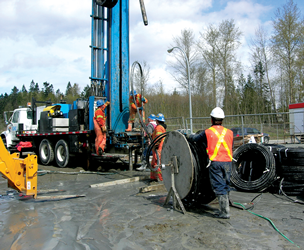
this case, it was a greenhouse nursery where the competitor’s rig had
only been able to drill about 50 feet in two weeks,” says Bill Fitzgerald
, general manager for Sonic Drilling Ltd, a contracting company based in the
“They
had hit lots of mixed sand, clay and gravel,” explained Fitzgerald.
“It’s hard sometimes for people to understand that we can just buzz
right through all that.”
“It
was a driller’s nightmare,” says Fitzgerald. “It was a
little tough, even for us.”
Under
the Langara site, the soil was a diverse mixture of sand, till and gravel and
littered with large boulders – daunting terrain no matter what kind of
rig worked it.
“You
can imagine how happy they were to see us do that,” says Fitzgerald, with
a grin.
With
speed like that, it’s clear to see that the costs per foot/metre when
using a sonic rig translate into significant savings and it’s just as
easy to see how Fitzgerald can claim that the sonic is actually cheaper in many
applications than its traditional counterpart. With a reputation for being the
fastest drill in town, sonic rigs are now boring their way through Europe, Asia,
North America, South America, Africa and the UK.
So
how did sonic drilling technology become so popular and, perhaps more
interestingly, who invented this rig anyway? The short answer to the first
question is, quite simply, that it’s the right tool for the job and, in
many cases, it’s the only tool for the job. The second question,
however, deserves a slightly longer answer.
The
history of sonic drilling technology is actually a story about the efforts of
many but it is Ray Roussy, president of Sonic Drill Corporation and Sonic
Drilling Ltd, who can clearly lay claim to the prize of improving the
technology to the point that he could patent his improvements and commercialize
a sonic drill that is both reliable and field tested.
Although
the roots of sonic drilling technology can be traced back to the work of George
Constantinesco, a Romanian intellectual who immigrated to England in 1910 and
published his “Theory of Sonics,” it would take many more years of
research by the likes of Romanian engineer Dr. Ion Basgan, American inventor
Albert Bodine (funded by Shell Oil) and engineers at the British-owned
Hawker-Siddeley before a viable drill was created.
As
one of those original engineers at Hawker-Siddeley, Roussy made the
life-altering decision to pick up the torch of sonic drill research and
development when the aircraft company experienced a downturn in the
1980’s and dropped the sonic project. Today, after 27 years of field
testing and development, Roussy has not only patented his super-performing drill
but he has succeeded in commercializing the vision of a man 100 years earlier.
How
pleased Constantinesco would have been to see the Roussy sonic drill in action
today; boring 3-10 times faster (depending on soil conditions) without using any
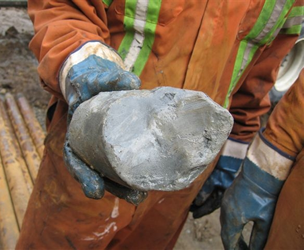
drilling mud and able to provide continuous core samples to depths of more than
300 ft (100 meters). It's amazing Canadian technology that keeps converting
skeptics into believers – a fact that Roussy hopes will eventually
revolutionize the drilling world, one geothermal loop at a time.